How I wrote my artist statement

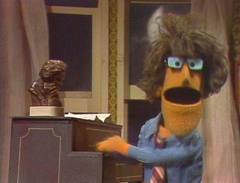
Anyone remember that Muppet (Don Music, above) on Sesame Street who kept trying to play “Twinkle, Twinkle Little Star” on the piano? He would almost reach the end, then play the wrong note. Then he’d groan, “OH, I’LL NEVER GET IT! NEVERRRRR!” (and, sproing: the sound of his head hitting the piano keys.)

That’s how I felt about writing my artist statement for a grant application. Lately I’ve thought about that Muppet, a lot.

Writing the artist statement was one of the most productive writing assignments I’ve had on this blog. Translation: it KICKED my ASS over and over again. It was excruciating. I actually tried to write an artist statement back in November, for this same grant, and I actually missed the application deadline. Uncharacteristically, I gave up. Now, I usually let the pressure of the deadline work its magic, and Just Do It. But I didn’t, and I missed the deadline. I decided that I wouldn’t let the deadline pass me by again.

What paralyzed me for so long was, really, two things. The first thing was the perfectionist voice: it BETTER be good. I can understand how artist statements can be bad for those who have not been taught how to write. But, some voice sneered, a writer’s artist statement better be GOOD. Writers write, after all. We usually don’t paint or compose music or use other artistic forms to express ourselves. Words are what we have. I’ve read some terrible artist statements, ones which made the artist seem incredibly pretentious, or ones which made me respect the artist less. So my internal editor voice kept butting in: ’that’s SO cliche,” “that’s how EVERY artist statement starts,” and so on.

The second thing that paralyzed me was an issue of identity. Having been a professor and a scholar for so long, and having worked so hard to get there, it was hard for me to switch gears and claim myself as a writer. Writing the biography of myself as a writer, as an artist, then, was invaluable, and I had to write that before I got to the artist statement. I had to believe that I was—no, am—a writer.

Now in my teaching, I’ve asked my students to write artist statements. I’ve emphasized that artists need to be able to talk about their own work intelligently. Our culture demands (and gains) access to the artist and creative processes. Because of this demand, artists who can talk about their own work are often artists that I respect.

But in this case, ironically, I couldn’t let myself trust the writing process—the very process that I kept emphasizing as a writing teacher.  As the editor Bill Germano says, “You don’t write to record; you write to discover.”
******
I wrote six drafts of my artist statement. Most of them felt miserable and inadequate. I complained most of the time. Which, come to think of it, is a pretty writerly process. I wanted to describe some of the drafts, so that if you are struggling with your artist statement, you could take some of the approaches below. Consider them writing prompts, or a mishmash of ways to brainstorm for the artist statement.

  • In one draft, I wrote three anecdotes about the things that I write about frequently.
  • Another draft made me erase the stories and anecdotes. I think I was trying to hide behind the stories, the equivalent of the artist’s plea, “Should my work speak for itself?” But on my way out the door for a run, some tough-love voice said to me: “No. You do know why you write what you write. To pretend otherwise is dishonest.” So I wrote for that voice for a little while. I did know why I write what I write; I just didn’t want to claim these things, and risk being vulnerable or wrong. I looked at the whys and the hearts of the anecdotes: what were the lessons or themes to take from the stories?
  • In another draft, I wrote about the things I’d like to stand for, as an artist: education, literacy, compassion, questioning. (In Bird by Bird, Anne Lamott calls this your “moral point of view.”) They don’t describe what I do write about, all the time. And that gave me pause.  I ended up putting these things into the statement anyway, because they do inform my work.
  • The next draft brought me to a more honest place. I looked at a bunch of things I’d written, and tried to find common threads and themes. These themes didn’t match the lofty goals that emerged in the earlier draft. But they felt accurate, and they felt sincere. And they felt raw.
  • Still another draft made me think about the emotional and psychological place that I inhabit when I write. The place where I’m writing freely and honestly, where I feel like I am doing good work. I thought about how I am scared by some of the things that I write, and I thought about Nikki Giovanni’s wonderful quotation, “If you’re not scared of your own work, it’s not doing anything.” And I’ve found that to be true: the writing that’s scared me the most is the writing that people respond to the most. That’s been my best writing. I thought about the strengths I try to access, the weaknesses I try to ignore, the wounds that I pretend don’t exist. I named those things, and I put them into the statement.
  • I also thought about my goals as an artist, and thought about them as goals that I haven’t reached yet, rather than descriptions of what I actually do. To do this, I had to admit that my work does not always match my goals. There’s the artist I’d like to be, and there’s the artist that I am. I think there will always be a gap between the two, and I had to make peace with that. I know very few artists that are completely happy with what they’ve released in the world—there’s always something you can do, something you can fix. And I thought about the artistic struggle between what the artist wants the art to be (or their original vision of the art) and the art that emerges.
  • I looked at the forms that I tend to use in my writing, in my blog posts and my creative nonfiction essays. I noticed that I like certain forms, such as the essay strung together with vignettes. I thought about the poetry classes I’ve taken, and how they’ve stayed with me because so much of my work is image-driven.
  • I thought about how I wanted to challenge myself as an artist, and how challenge is a goal for my writing. I do want to challenge myself, and I want to keep learning. I added something in the statement about how I value the work that is making art.

I sent the draft, a sad little cluster of sentences, to a writer friend from Twitter who generously offered to read it. She gave me wonderful and thorough comments on the rest of the application, including a biographical statement. But she liked that little cluster of sentences. I knew I had to write more. And that was enough to get me through the rest.

Most of all, I wanted the statement to clarify my writing. I wanted it to illuminate my writing, the way that sunlight illuminates the colors of stained glass. What emerged is not a great artist statement, but I think it describes what I do, and clearly. It’s a good beginning. I know I’ll revise it again. I’ll revise it one more time, and put it up here in the next post. I’ll try to add more about what I learned about artist statements, too.
I’m just glad I made it this far. For now, I want to remember how it felt when I finished that last draft. How I closed my eyes and took a deep breath before I hit “send” on the grant application. “It’s taken me twelve years to return,” I wrote in my biographical statement. “But I’m a writer again.”
Beginning the book

I’ve got an idea for a book, and I’ve got some drafts of pieces. So what’s next?

Well, I’ve been thinking a lot about how to structure the book overall. There are a number of pieces that I’m juggling, several historical time periods, and at least several plot lines (my dad’s incarceration, his untimely death, my own job loss and the writing of this book). And a whole bunch of smaller pieces about each “document.” It’s quite a lot to juggle. I’m not exactly sure what story I want to tell, and so much of the writing will be about discovery. I know that I want to begin with an introduction of mine, and then move into physical documents, into virtual documents (like Facebook and blogs). And then end with a memory. It’s not quite a linear approach, but I know that non-linear can really turn people away from a book (‘too difficult to follow”). We’ll see if the book really ends up this way.

So I’ve begun to write a draft of the Introduction, which feels really exciting to me. As I’ve been reading (and rereading, obsessively) Anne Lamott’s wonderful Bird By Bird, it strikes me that her Introduction does some of the work that I’d like my introduction to perform. It establishes trust and intimacy with the reader, and it does so with humor and wit. My book has heavy subjects (wartime history, death, loss), but I don’t want it to be a “downer book.” I do want it to be helpful for people who have gone through similar situations, or who are going through similar situations, but I don’t want it to be A Grief Book. So I want my introduction to establish me as a narrator, but a narrator that will bring people into the story, rather than pushing them away or putting up barriers right away.

I’m also feeling how the Introduction can and should be longer than the blog posts that I write here. I began writing as a poet, really, and longer forms terrify me. So creative nonfiction lets me integrate some of the sensitivity to language and keeps me grounded (at least for now) in a reality. The idea of writing fiction terrifies me, even though I have an idea for a novel already in mind. Maybe I’ll need to start with short stories after this.

Some books that have helped me think about structure, in no particular order:

  • Anne Lamott’s writing advice book/memoir, Bird by Bird (juggling of many pieces, intimate, funny)
  • Diana Abu-Jaber’s novel Birds of Paradise. This lovely novel uses multiple third-person viewpoints, but also surprised me towards the end.
  • Kim Severson’s memoir Spoon Fed. Each chapter here centered on a different “subject”, a woman who inspired or changed the author, but changed it up a bit, because it did not approach each subject the same way. To do so would have felt repetitive, and I’m glad she structured the book this way.
  • Rebecca Skloot’s biography The Immortal Life of Henrietta Lacks. One of the very best nonfiction works I’ve ever read, frankly. Skloot juggles multiple time periods, jumping back from our contemporary present back to the 1940s, 1950s, and so on. She also juggles multiple subjects, including Henrietta Lacks, and her children. And—this is a move that I greatly respect, especially because Skloot is a journalist—she examines her own role in the writing of the book, critically and thoughtfully. Skloot has said, I think, that the novel Fried Green Tomatoes helped her to think about how to structure her book, so perhaps that’s a lesson for me to consider. (Outlining Flagg’s novel might be interesting, just in terms of timing.)

In the meantime, though, I am working on a grant application. Lots of people are applying, I’m sure, so I’m trying not to get my hopes up too high. But it’s useful to work on this application because it’s another step towards writer identity. I’m having to write down my goals as an artist, and to think of my biography as a writer. And those two exercises, alone, are also worthwhile for me to progress towards this degree, another step in the MFA.
Back with another post next week. In the meantime, if you can think of any books that would be interesting for me to read, because of their structure, I’d love the suggestions.

My Father In A Facebook Age

Oh, I think he’d be all over Facebook.
Even if he died before e-mail, before cell phones,
before desktops or laptops,
before dot-coms, before the Web had a capital letter.
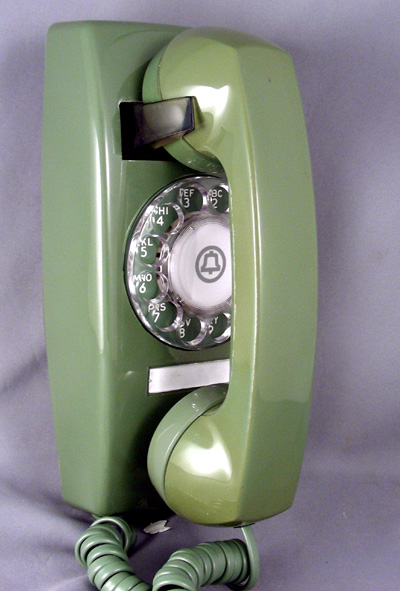
Our olive green rotary phone still had a bell. And a cord.
An Orwellian year, we thought, nineteen-eighty-four.
Who knew then what we would want to see?

But I can see him now.
He’d post pictures of his granddaughters,
narrate his online travel slide shows,
review The King’s Speech,
tell you about books he’d been reading,
rejoice over the latest Giants or Niners win.
I can see him writing status updates,
searching Epicurious for his dinner parties,
asking me about Twitter.
He’d still be playing all-night chess games
with my cousin, just on Facebook.
(A show tunes guy at heart, yes:
he might even DVR Glee.)

Before Dad died
he bought one of the first VCR’s,
the remote control still
attached to the silver machine
with a long black cable.
Over decades of photography
he took rolls of black-and-white photos,
carousels of color slides,
albums upon albums of Polaroids.

The film changed, but not
his love of holding on to the moment.
Dinners were for eating together,
houses were for gathering the family.

So I think he’d know what to connect, and how,
and why.
I think he’d know what all this noise is about.


(A bit of fun here, while I’m working on the introduction to the book. More on next steps in the next post.)

My own private MFA: the final project proposal

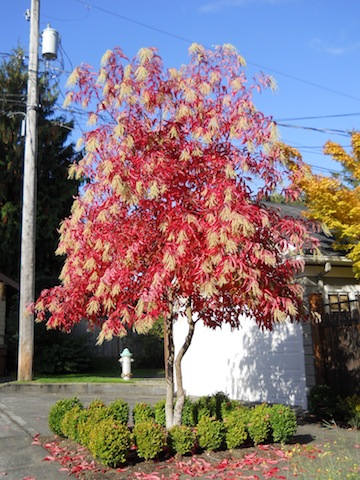
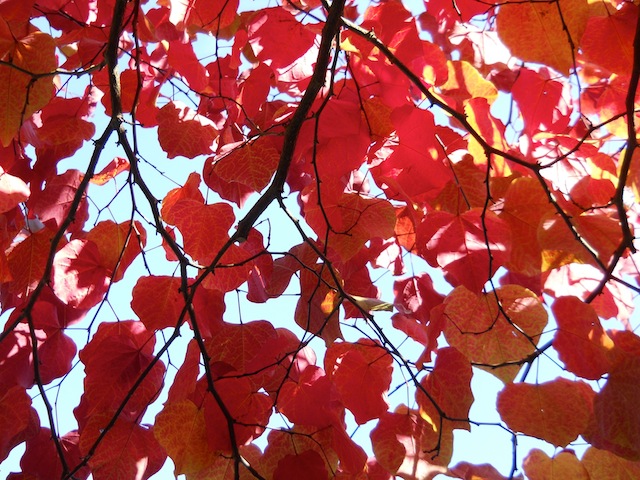
Thanks for all your responses, here and elsewhere, to the last post about beauty. I loved reading what everyone had to say. I’m trying to hold onto that momentum, and trying to remember how lovely the trees were last fall (see that picture above?). It’s been a bit gray here lately.

Coming into Year 3 of this private MFA and the second anniversary of this space, I’ve been thinking about the Final Project. Yes, I’m on the 3-year program. Tortoises, represent.
I’ve been doing a lot of reading still, which is lovely. I still find myself itching to get things when I’m in bookstores, but I no longer feel the rush to buy the latest must-read or bestseller when I’m there. Instead, I find myself making lists of things to place on hold at the bookstore. Now, I know that writers need to make a living (boy, do I know), but it’s also gratifying to know that the books I really want to buy now are the books that I want to keep around forever.

I’ve been drafting pieces of my book project all along, here on this blog, as well as in a separate document that I call “Book journal.” But the other day, I realized that I haven’t really laid out what the project will be for you, here in this space.

So it’s a good time to describe the final project of my private MFA to you. I want to tell you more about it, to give the project some needed rejuvenation, to kickstart me back into action (remember, go) and to bring some narrative flow back to this space (for you non-lit types out there, some “what’s going to happen next?” action).

I’ve been thinking about it for so long, I can’t believe I haven’t explained it to you properly. I wrote about an earlier version of it in a writing contest, almost 2 years ago. Over the last year I’ve been reorienting myself to life outside the academy, rethinking myself into writer identity, and looking for a job. But lately I’ve been talking about the project to a few people, and I can feel some energy coming back. And I’ve found that two things motivate me: 1) making lists, and 2) making promises to other people.

Here’s the project. And aaaaah, I can feel the fear creeping up as I type, so I better type fast. I’ve been trying to figure out how to explain the book, and I’m going to keep figuring it out over the course of the project. So this is not my elevator pitch, or my NPR “Fresh Air” draft, but another draft of my explanation to you.

I’m writing a memoir.

It’s a memoir about the aftermath of two—no, three—major events which have affected my life. The first event is my father’s death. He died when I was 10 years old. The second event is the Japanese American incarceration of World War II, which affected my father’s life and continues to affect my own. The third event, the one that made me turn to writing this project at all, is the loss of my job and my return to the writing life.

Here’s another way to explain it: it’s a triple-voice memoir, one that intertwines my writing, my sister’s artwork, and the voice of our father, who died when we were very young (10 and 6 years old, respectively). We have our father’s voice in many things, but perhaps most concretely, we have it in an unpublished memoir manuscript that he wrote about his incarceration experience. I plan to intertwine parts of my father’s manuscript, some of my sister’s artwork about memorials and memory, and my own musings about the aftermath of death, as well as the aftershocks of camp history. For right now, I want to organize the book into chapters using different forms of documentation, and writing about the different forms of memory that they evoke. For example, there will be a chapter about a family recipe, a chapter on the albums of Polaroids that he took of me when I was a baby, a chapter on his diary when he was in the military, well before I was born. There will be a chapter, or a series of chapters, about my dad’s typewritten book manuscript itself. I hadn’t seen the manuscript in twenty-five years, until I reread it a couple of summers ago. And when I began to read, I realized just how much I hadn’t worked through my feelings about his death.

And yet here’s another way to explain it. No one knows everything about the lives of their parents. When they leave us, they leave so many unanswered questions. I wanted to look at one particular stretch of time when I know the least about my father’s life: the time after his memoir, after his wartime incarceration, and before he married my mother.

Writing has helped me to clarify and discover and process what I’ve learned about my father’s death, and myself, and memory, over the last two years. So it’s a book about a writer’s (and visual artist’s) struggle between loss and memory, the ways that we memorialize our dead in an age where so much information is “in the cloud.” In some ways, it’s a present for my daughters, who never got to meet their grandfather.

Over the next few months I’ll share pieces with you, some revisions of blog posts, and updates about the writing and publication process. I’d love to hear what you’re thinking about the project in process, and I look forward to sharing the journey with you. I’ll continue to post intermittent musings like these, so it won’t all be about the book. But I need to move forward, to keep writing, and to keep moving towards this bigger goal. Comments mean a great deal to me, even a quick line or two, so please don’t be shy. I promise to respond, too. Thanks.

Beautiful

I am cringing as I type this word: beautiful.

Don’t get me wrong, I’m not against beauty. But I’m going to write this post about a picture that a friend of mine took recently. And the picture was of me.

(Squirm.)

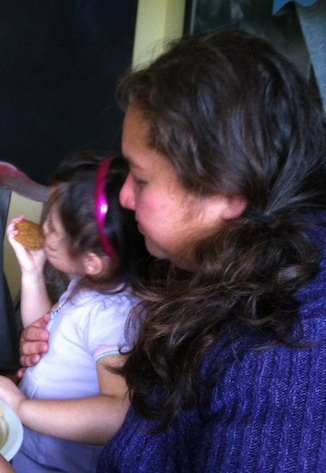
We’ll get to that picture in a minute. For now, we’ll start in profile, with that picture above.

*****
I’ve written before about one of my favorite writers, Anne Lamott. (She is visiting Tacoma to speak next month. I squealed when I saw this announcement.) In her book about writing, Bird by Bird, she talks about the rewards of writing a present for someone that you love. And she’s absolutely right: I’ve written several short presents. I have loved writing them.

Writing presents put me in a kind of “flow” state (happy, focused, unaware of time passing). Doing this means that I am devoting myself to the task and loving it, and thinking hard about the recipient all the while. It’s the same state that I am in when I am crafting, just putting paper and glue or yarn and ribbon or other odd materials together. It’s one of the easiest ways to get me to create, and to be creative. (Side note: does this mean that I might write the memoir by making it a present? I’ve been rereading Isabel Allende’s memoir The Sum of Our Days, addressed to her daughter Paula who died young of porphyria.) It’s the act of giving and creating with someone very specific in mind.

So I wanted to write a present, to write a sort of longer thank-you note, to a friend who is going through a difficult time.

*****

Back to our original word, which I’ve avoided for a few paragraphs now: beautiful.

A few weeks ago, my friend and I were having lunch at a new restaurant in Seattle. We slurped up fresh (!) udon noodles and crunched our way through our selections from the tempura bar (!). Kabocha tempura is one of my very favorite Japanese foods. Hers, too. In line, we were both willing to wait for some more.

My friend’s a wonderful photographer and she was taking pictures throughout our lunch. We got to watch the workers make the dough for the udon, and run it through the pasta machine. And because my friend writes about food, she took pictures of our lunch. So it shouldn’t have surprised me when the camera came out again, toward the end of lunch.

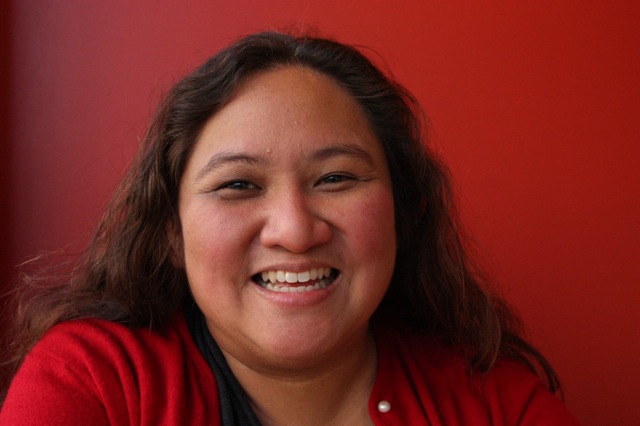
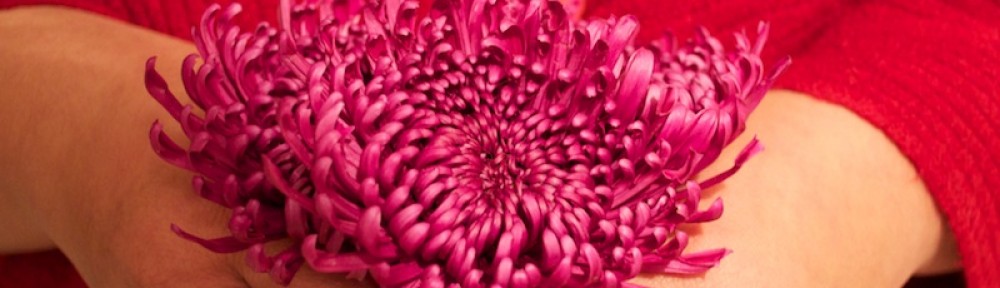
“Could I take a few pictures of you?” she asked. “You just look so beautiful with your red sweater against that red wall.”

“Um, sure,” I must have stammered. Because then the camera with its impressive lens was clicking away at me, and while some folks know what to do when that happens, and revel in it, I have never really been one of them.

See, despite repeated reassurance from my parents and my husband, who are not to blame in this scenario, I have never really owned the word “beautiful” for myself. Cute, maybe. Pretty, maybe. Sometimes. But beautiful just takes it to a whole other level. And I’ve never been comfortable there. The picture up at the top of this post? Profile picture, most of me hidden. Much more comfortable.

Call it unresolved adolescent insecurity, perhaps. Call it a swallowing of so many magazines and movies and TV shows about a few selective types of beauty. Call it a not-fitting into any traditional, petite-Asian woman definition. Or call it not-fitting into athletic definitions, either. I’ve been practicing yoga for almost 4 years, but I don’t buy ventolin inhaler australia have a typical lithe and supple yoga body. I’ve been running for over a year regularly, but I don’t have a typical lean runner’s body, either. (I do have a medical condition that causes me to build up more muscle when I exercise, and thus makes it harder to lose weight.) Perhaps more accurately, call it a lingering unhappiness with myself, which—happily—seems to recede the older I get.

When I see pictures of myself, I tend to focus on some sort of flaw: my flat and wide nose. A double chin which, I am happy to say, seems to be in recession at the moment. Or my eyes, which narrow far too often in judgmental self-awareness and analytic self-consciousness. Or my round moon face. I am rarely happy with photos of myself, which is sort of sad, but it’s the truth. The best pictures of me when I was young are not usually ones when I am looking at the camera.

But there was my friend across the table, happily taking multiple shots of my face!—mostly just my face! I chattered nervously while she took more pictures. She had me look off to one side for a little bit, maybe to get a different angle, maybe to help me feel better again. More soft clicking from the camera. Then I looked back. Smiled some more. Sometimes I opened my mouth a bit to smile, sometimes I closed my mouth.

She sent me a few of the shots later on, and I loved them. I have needed a new “head shot” for a while, and I knew that I wanted something different on my Twitter feed, on my Facebook page, on LinkedIn, and here in this space. I especially wanted one for this blog, for readers who haven’t met me yet. So I added one as my profile picture on Facebook. Positive comments and “likes” came in—“radiant,” “stunning,” and there was that word again and again, “beautiful.”

I took all those words to my shy, bookish, adolescent, nerdy fat-girl heart. I cherished them like pop-song lyrics, repeating them to myself over and over again.

*****

In Tayari Jones’s compelling novel, Silver Sparrow, one of her two adolescent-girl narrators talk about what it is to be “a silver girl”: the beautiful girl who seems beloved of fate and fortune, who seemingly never has to worry about her looks or her life. Of course, we also read the novel partly from the “silver girl”’s point of view, too, and we know that she has just as many things to worry about. But despite so much evidence to the contrary, some insistent part of me has never quite stopped believing that physical beauty makes one’s life so much easier and happier. And, as a corollary, that same part of me has insisted that I would never be physically beautiful, and never have been.

My mother? Stunning. My daughters? Radiant. Everyone has said so. People might love me for my nice-girl personality, or for my enthusiasm to make them read something new, or for my baked goods, or for my fancy-menu writing that makes them drool. Me? Beautiful? No way.

But whose definition of beauty have I swallowed all these years? And what stops me now from reshaping that definition? Why should I care so much about physical beauty?

And yet I love the picture that my friend took of me. Because to see your own beauty as your dear friends see you—that is, to see yourself as your friends and loved ones see you—is no small gift.  It makes life so much more than easier and happier.

Maybe my reshaping of beauty starts here, with more words from Anne Lamott: “Joy is the best makeup. That, and good lighting.”

Thank you, dear friend.

Word for the Year

And a Happy New Year to you. We’re just starting the lunar New Year, right? So that’s about as good a time as any to come back to this space.

I’m not trying for New Year’s resolutions, but I am thinking about a word (or words) for the year.  Resolutions tend to set us up for failure or too-high expectations, and they remind me uncomfortably of diets—a lot of inflexible rules, a lot of can’ts and shouldn’ts, instead of encouraging permission slips.

Words for the year are different. If you work near a window (and I hope that you do), you might know something about what windows can do for you and your work. Working indoors means that you focus a lot on what’s right in front of you: your keyboard, your coffee cup, the stack of papers with their separate demands. Every once in a while, though, you glance (or stare) out the window. That glance reminds you that there are distances outside the rectangle of your desk, and that there’s a different quality of light besides indoor light bulbs.

Words for the year work for me just that way: windows that reset my vision, that remind me to refocus and expand.

Last year’s word was light. I wanted to focus on light—sunlight, for example, and it was a particularly un-sunny year. I wanted to run, but only if I didn’t take it too seriously. No agro mixes of Beastie Boys or Franz Ferdinand for most of the time—no, I wanted the Fleet Foxes. (Fleet: light: coincidence?) I wanted to write if it was light and fun. (It was.) I wanted to remember just how much love, and thus how much light, I have in my life. I wore a Larimar pendant almost every day, to remind me of the luminous sunlight and tropical ocean water of the Dominican Republic. Light got me through a lot. Somehow that worked, I think. I can go to intermediate yoga classes and keep up. I can run farther than I ever have, and running is not the torturous act that it once was. Though I used to hate being upside down for most of my life, I can rest comfortably somehow in a headstand.

Quick digression: I didn’t know what headstands meant for me until recently, either. I was talking to one of my yoga teachers about how I’d hated being upside down when I was little. Didn’t like loopy rollercoasters, or even somersaults, or even dangling over a couch arm. “Why is that?” she asked. “Is it a control thing?” Whoa. I stopped short. Oh, crap. “Y…eaah. Probably.” This feeling of being upside down is, like much of this uncertainty, probably very good for me. I’m starting to pick my way through the woods of uncertainty again. I am going off the comfort of stability and beaten albuterol no prescription paths and clearly marked trails.

So this year’s word? It’s closer to the intent of a resolution. It might be go.

I’ve got an artist statement in the works. Last year I tried to write one as part of a grant application, and it was terribly painful. I couldn’t even finish. The inner editor and critic had a field day. “I’ve always wanted to write and read ever since I was a little girl…” Bleahhhhh. Having been a professional literary critic for so long, it was humbling to have to write about my own writing. “Why do I write? Shouldn’t the writing speak for itself?” the writer-artist in me pleaded. No, that’s not what foundations (and publishers and agents, I imagine) want to hear.

So I had to look at what I do write, and what I have written. What are the issues that I write about the most? What do I want to accomplish as a writer? See, if you asked me what my teaching philosophy was, I could have told you about that easily. And really, the Nigerian author Chimamanda Adichie actually said much of what I would have wanted to say in her wonderful TED talk, “The Dangers of a Single Story.”

But as a writer? My hunch is that I will have to write more before I have a more developed writing philosophy. Nevertheless, given what I’ve written, just in the last year or two, I have a better idea of what’s important to me. I want it to be more like my teaching philosophy, infused with principles and politics and social justice. What I have so far is much more personal, but at least it is honest. So far it’s about loss and memory. I wrote a draft, but I’ll have to take another whack at the statement and get back to you. I just have to do it. I have to tell myself: just go.

Go can also be part of letting go. A few days ago, I recycled several bags of papers from my old life. That night, I had a series of dreams about being a published author, preparing for book readings. I had the excitement, the nervousness, and the adrenaline. I always woke up before I started reading, but I woke up happy.

Go means that I can probably go to more intermediate yoga classes, and that I can step up my time and pacing on my runs. Go reminds me to just apply for that writer’s grant, to publish the blog post, to revise the book proposal. I’m getting close to forty, and that’s as good a deadline as any for a first book. Go reminds me to write.

Go is the window that both reminds me to rest, yet pushes me out into the distance.


(What’s your word for the year?)

What uncertainty looks like

“We just need to get to the ocean,” Josh said.

Really? I thought. As much as I love the ocean, I wasn’t sure if we should really go. We have two littles, after all. Even with each other, with rock-paper-scissors,  drawing materials, and an Ipad for company, they can get impatient on road trips. Did I really want to drive for about three hours out to the coast just for one night on Thanksgiving weekend?

We hadn’t gone anywhere on a family vacation, getting-away-for-getting-away’s-sake in far too long, almost several years. Over the last few holidays, and over the last two summers we had promised ourselves a vacation, even a staycation. Things never quite worked out, and money was far too tight.

But we had to get away. It had been a month of waiting, layered on top of other months of waiting, layered on top of months of career transition. A couple of weeks ago we’d been waiting to hear about job news for me. When news came—not quite a simple yes, not quite a simple no—I had to rethink what uncertainty means, and what stability would mean.

*****

Despite my slight misgivings, the four of us piled into the car. I’m a terrible camper, because I want to take EVERYTHING with me. I packed ridiculous amounts of clothing and two grocery bags of snacks for the girls, for an overnight trip. We drove down the coast. On the way down we drove over long bridges, crossing wide rivers, and as we neared the coast, we caught glimpses of the ocean behind the hills. But then we got to the cottage, half a block from the beach. We knew we had to catch some time on the beach before it got too dark; the Northwest winter sunlight ends by 4:30. So we bundled up, and walked out to the sand.

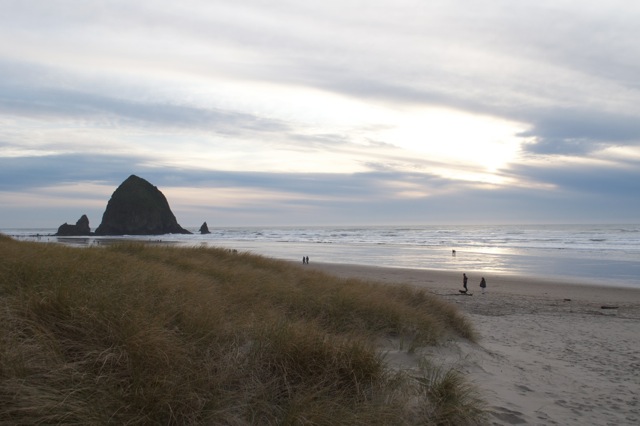
To our left, Haystack Rock reared its head. It was low tide. Part of the beach was so wet, it seemed to overflow with pieces of sky. The wind whipped around me, the horizon stretched into the distance. And, there, unexpectedly,  were all those crucial times I’d spent near the ocean.

There were all those coastal road trips that Josh and I took to the Oregon Coast in grad school, before grad school. We’d been to Cannon Beach, and Manzanita, and Coos Bay: quick weekend trips, or even part of a week.

There was our honeymoon, where we drove back from Mill Valley and San Francisco to Seattle, up the coast. That week we saw more moods of the Pacific than I’d ever seen, from an optimistic turquoise to a stern cobalt grey.

There was the morning after we’d slept next to the ocean in a cabin. I woke up to the sun rising over a village where the Russian River meets the Pacific, in California. It wasn’t the sunlight that woke me up that morning; it was the reflection of the light on the water, as pink and as golden as the haze in a Maxfield Parrish painting. I looked over Josh’s shoulder, and saw that glorious light.

Why was I surprised that the beach would insistently tug the memories right out of me?  It was the power of the waves: pounding slowly in, pancaking towards you, and foaming away. It was the sharp wind, clear and cold in so much open space. And this surprised me: it was the sound of the ocean that I’d missed the most. Oh, we have polite wavelets in Puget Sound. But nothing like these waves.

And it was the pull of the horizon—it stretched so far away, I couldn’t really see where it ended.

*****
Back at the beach cottage, the little girls were simply thrilled to be somewhere else for the night. They squealed their way through each bedroom, opened each kitchen cabinet, and climbed onto the mountainous easy chair multiple times. The toddler, who loves putting things away, happily unpacked her clothes into a dresser and began work on my overnight case. I laid on the couch, as relaxed as cooked spaghetti. By nightfall I had a book in one hand, a toddler sitting on my stomach and the other curled up next to my legs. We were all in front of the fireplace, content as kittens. Josh had gone grocery shopping and was making us something with pasta in the kitchenette.

Lying there with the girls, my memory traveled still farther back. In seventh grade I visited Mendocino with my GATE class. For part of the trip we sat near the ocean in near-silence, and wrote about what we were hearing and seeing. There I wrote some of my first prose poems. It was my first stream-of-consciousness writing, and words poured out of me almost faster than I could write. We also made lists of our favorite words, and had to read the first fifteen words out loud. (As steeped as I was in fantasy novels at the time, I remember that unfortunately the word “darkling” made it onto my list.) But I  remember a certain small silence that fell over the group after I’d read my list out loud. I was so uncertain and so afraid of so many things, but even then I knew that I wanted to be a writer.

In our cottage, I left the bedroom window open before I went to sleep. And the ocean roared all night long.

(P.S. Photo credits here should go to my husband, Josh Parmenter. The batteries on my camera were out that day.)

One more breath

Just to be clear, because I don’t want to scare anyone, everyone’s fine here.

I’m not talking about one last breath; I’m talking about one more breath. If you practice yoga, you know what I’m talking about. I’ll come back to this in a minute. While you wait, you can take a look at the picture I took, over left there. It’s a tree that I pass every day when I drive back from my yoga studio.

*****
So: I’ve been looking for a job.

I’m not going to write too much about the career change here, for a number of reasons. Maybe I’ll write more later. But I can say that the job search hasn’t always been easy. I’ve had a job or some version of a job since I started college. Nevertheless, I’ve been lucky in so many ways.

I have the very best of partners, the one who surprises me with a copy of this book by one of my favorite authors, the one who nudges me to go for a run when I’ve got anxiety to burn, whose belief in me is bedrock to my days. I have two adorable daughters who constantly make me laugh and teach me to discover the world anew. I have the very best family who has taught me about resilience through the courage of their examples. I have the very best friends both “on” and “offline,” who bring me presents like this book and send me messages and hugs and go out for coffee, where we analyze and then take over the world. I have roots in my community, and friendly faces at my grocery store and the playground at C’s elementary school, and my yoga classes. I’ve got a house that I love in a neighborhood I love. And during my unemployment I’ve been able to do a lot of writing, for causes and people that I support. If it takes a village to raise a child, I can tell you that it’s taken my village to support me during this time, and I’m so grateful for you all.

One of the most difficult (and in some ways, interesting) parts of the job search has been thinking myself out of one career and into another one yet to be determined. I spent almost 12 years thinking myself into that last professional identity; that career seemed to carry so much certainty and forward movement. I loved parts of that job, and I will miss them dearly. But as things stand now, I will probably be leaving that career behind. I’m glad that I get to keep so many of the relationships that I developed in that time.

I’ve been applying for jobs for about four months now, and I think there’s some light at the end of the tunnel. I’m excited about the possibilities. In a job market like this one, I’m extremely grateful that I even have possibilities. But right now, I need to wait, for at least a few more weeks.

Last week, the waiting room space was just about to drive me a little insane. The suspense, the tension, the lack of resolution. I wanted to scream, or go for a run, or tear up a hotel ventolin inhaler no prescription room, or preferably all three. “Why does it take so long?” my 3-year old likes to ask. “Because you’re not being patient,” I like to answer sometimes. And last week I realized I’m not being patient. (Great: just like my 3-year old.)

For the first time in my life, I understood the idea behind Waiting for Godot, if not Waiting for Guffman. I wanted to write a play called The Waiting Room. You know: the set would be furnished with bad landscape art, and old issues of Good Housekeeping, and Journey’s “Don’t Stop Believing” played on Muzak panflute. The main character would be waiting, unable to leave the room until someone else unlocked the door for her. People would come to slide unexpected presents under the door, and talk to her through the windows, but she couldn’t leave until it was time.

But of course, I didn’t know how the play would end. I suspect that I’ll just have to write it and find out.

*****

And here’s where I’ve come to appreciate the beauty of “one more breath.”

Yoga teachers often say this phrase to you when you are holding a pose—let’s say, downward-facing dog, or Warrior 2—and they want you to stay in the pose for just a little bit longer. They usually say this to you when you’ve been in a pose for a while, or for a little longer than you’d like. In those poses your legs might be screaming like 1960s Beatles fans, your arms might be stretched out taut as John and George’s guitar strings, and the rest of your muscles might be protesting like Beatles fans stranded outside without tickets.

In that kind of tension, “one more breath” can feel like a very, very long time.

If the pose is especially challenging, “one more breath” is the very last thing you want to hear. Some days you’re kinda pissed, actually, that you have to stay there a bit longer. (Not at your teacher. Don’t get pissed at your yoga teacher. They can make you hold poses even longer. If you’re my yoga teacher and you’re reading this, I don’t mean you.) But I’ve decided—and this must be yoga rewiring my brain, I can think of no other way to describe it—that “one more breath” is one of the very best things that yoga can give you.

See, in yoga the breath becomes a way to measure time. The space of “one more breath” is where you’re challenged, you’re waiting, and (somehow) you’re calm. In those few seconds you hold the pose. Sometimes, it’s true, you fall out before it’s time to move to the next pose. But more often than not, you stay in the pose, and you keep breathing. Your mind and your body say together, “It’s okay. You can do this. Just a little bit longer.” You learn to inhale slowly, in, and exhale even more slowly, ouuuuut.

There, you realize it: one more breath is really just fresh life, waiting to rush in.

Why I Write

(In support of National Day on Writing, here’s what I tweeted, using the hashtag #whyiwrite.)

My oldest daughter came home excited from school one day: “An author is coming to visit! Can I get his book?”

She began to write and storyboard her own books shortly after that.

That’s the kind of magic I’m talking about.

(More news and a giveaway, and my homage to Twitter, coming up soon! And, you too can play along: why do you write?)

Assignment #7: Blackberry poem

Blackberry Picking: A Poem For My Daughters

Sometimes I think
that the secret is to look for berries as if you were a small animal.
(Wait: you are small animals.)
To search for fruit the way the plant wants you to see it.
The plant actually wants you, small ones, to find the berries.

So, step on the thick thorny vines that get in your way—
blackberry vines can take that, trust me,
so wear good shoes—
and then lift the vines up.
Maybe use the leaves themselves, as gloves, then lift,
and then the clusters of berries will appear.

But you’re not done yet: are the berries ready?
If they’re dark purple, that’s one clue.
Are they a little bit soft? Do they give, just a little, to the touch?
Then they’re ready.
I like to use my thumb and first two fingers to gather albuterol online together,
nearly a kiss, closing on the end,
And then pulling gently.
I think about the way the plant wants to be harvested:
a small animal mouth, a soft tug.

And of course I worry about all those thorns.
But I want you to have as many thorns as you need.

I want you to protect what you know to be tender.
I want you to grow thickly stubborn as vines,
the ones strong enough to protect and nourish and shelter,
who fight for all the sunlight they can find.
I want you to know the ecstasy of the harvest, the harvester and harvested.
I want you to know about the scratches and the stings
and always, always, always, the going back for more.