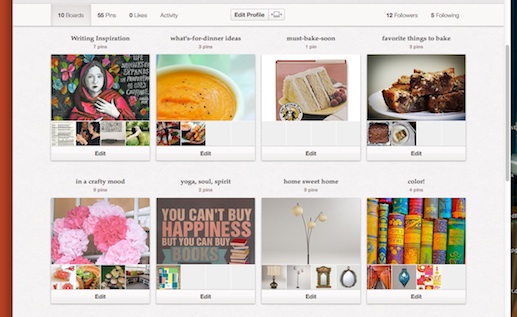
Pinterest for writers

(Or, one writer on Pinterest. You decide.)

Hi there, and happy new year. My name is Tamiko, and I just used Pinterest as a writing tool. Still with me? There is, as always, a back story.

My sister asked me to join Pinterest so I could look at some images that she’s got there. So I rejoined, having lost my original account when the whole deal was still in beta. Friends from Facebook started finding me on Pinterest, and my e-mail started pinging with notifications. I asked my Facebook friends to be patient with me, since I really had no idea about what I was doing there. I asked them for tips on how to work with Pinterest, or if they enjoyed it, or how they liked to use it best.

Some of my Facebook friends described Pinterest as “more addictive than Facebook.” I have also heard some describe it as the least stressful, lowest-maintenance form of social media, because you don’t have to interact with anyone (necessarily) or gain followers or start conversations. The most appealing descriptions made it sound like a place to arrange your own bookmarks, save recipes, or daydream visually. One friend said that she had a vision board there. Those descriptions sounded fun.

I started “pinning,” or (for the unPinitiated) adding images from sites that I liked, to different “boards,” or subject areas that I created. And oh, it was “luscious,” as another friend put it to shop through different lamps at Cost Plus, and think about the things that I would like to buy for our living room. So pretty! So sparkly! And I liked looking at all the colors together on my boards. I keep wanting to integrate more color into my everyday life and surroundings, and looking at my Pinterest boards does make me happy.


There are aspects of Pinterest that concern me, for my own personality and habits. It can be addictive, another form of fracturing my attention. Already I can feel myself thinking, “Oooooh, I can pin this on my ___ board”—after I update my blog (so 2000s), check my Twitter feed, add books to my Goodreads account and update my Facebook status. I’m not sure I need another thing online to monitor and update. And as a book writer, I need longform attention to read, to write, to think beyond 140 characters or 320 pixels. When you get to the Pinterest home page, you are greeted with more images to click, and when you get to your own home page, there are even more of the same from the people and boards that you are following. It can be overwhelming, unless there is another way to monitor and organize the “boards” that you follow from different people. (There could be. I don’t know yet.)

And so much about Pinterest that I’ve seen (thus far) is about desire: things you’d like to buy, projects you’d like to make, recipes you’d like to test, places you’d like to travel, wall decor for your bathrooms… I should mention that I do have a friend who has created a board of “pins completed,” which sounds like a useful way to keep yourself a bit more accountable instead of adding to an ever-increasing to-do list of pins. I could see myself creating a big list of recipes to cook that I hadn’t cooked yet, and a list of house projects that I hadn’t started (or finished) yet, and feeling pretty terrible.

What worries me the most about Pinterest—again, for myself—is that there is very little space for appreciating what I have. As far as I can tell, the Pinterest gaze looks outward and forward, rather than inward or backward. After a while it felt like looking for my own reflection and having to search for it, over and over again, in the mirrors of other people’s houses. Something like the rabbit hole or funhouse of the Internet search itself. (Alexander Chee, who writes some of the finest online essays I know, has a short one about distractions, writing, and the Internet.  One of the best passages:

“The next time you find yourself helplessly in the grip of some internet rabbit hole, take a slight step back, and don’t stop yourself, but ask yourself what it is you are really after. What are the feelings you feel?…[and] whatever it is that is so distracting, would you write more if you wrote about it? Does it want, in other words, to be your subject?”

But one of the Pinterest things I decided to try, on a whim, was to create a “board,” a collection of links and images, for the book I am writing. And, wow. I actually want to keep this board around, and I hope I’ll be able to save it elsewhere somehow, with the other book-related materials. The part of me that keeps jumping ahead to publication says that this Pinterest board could even be part of a marketing tool for the book. Readers might want to know more about certain pieces of the book, and they could look at the board for more information. You can see the entire board here. (I don’t know if you have to be a Pinterest user to see it, so let me know if you can’t see it and you really want to. [Not that any of you need more things to see. I know.])

I started with an image of the place in Northern California where my dad and his family ventolin were incarcerated, Tule Lake. I made that the cover image.

Source: nps.gov via Tamiko on Pinterest


Other images followed from sites that I’ve discovered while I’ve been writing and researching the book. An interview with the current poet laureate, Natasha Tretheway, about history’s erasures and memories. A Rumpus article about grief memoirs, another about the genre of memoirs. An Atlantic article about photographers using technology to bring together separated families on the same page, in the same picture. An article on Yoga Journal about a woman who created a yoga workshop specifically for those who are grieving. A national resource center for children and teens who are grieving. A post from my own blog (ooh, I can pin my own content?) to remind me of things that I discovered while writing about grief.

The library where my dad worked for so many years, at Cal State Sacramento.

Source: csus.edu via Tamiko on Pinterest


And an image of my sister’s incredible artwork (which I  want to include in the book) of my grandfather’s funeral and the mandala she created over it.


The work of putting the images together was partly frustrating, partly satisfying. Frustrating because as much as I loved working with these images (I usually work in text), there were sites that are important to me and my project. And because there was no image to be “pinned,” I couldn’t add them to my board. There are sites with important paragraphs that I want to read over and over again, and the images were not usable or interesting. I went back through my book journal and tried to find pinnable sites for the board; some worked, others didn’t. It would be nice to have a place for all of them, on a virtual visual cork board like this one.

The satisfaction, though, was the surprise. For example, I don’t know if I ever would have searched for an image of the library where my dad worked. But now, every time I see it, I think about all times I went there, visiting him at work. He used to take me and my sister to every single floor of the library, showing us around, and (yes) showing us off to his co-workers. Just seeing the image made me remember all of that. So it was a good reminder of what the image can do, and how the image lets us viscerally access what text does not.

Captioning each image helped me to do some unexpected short writing assignments for the book. Sometimes I wrote important quotes from the interviews. Sometimes I wrote notes about what the images meant to me. Sometimes I wrote and actually discovered something new about the image for myself. I grabbed an image from the book I’ve been meaning to get, Colors of Confinement, an extraordinary collection of color (color!) photos from camp. As I wrote the caption, I thought about what it means to see camp in full color, when we’re so used to seeing and thinking about camp (at least in the present) in black-and-white, the somewhat distant historical past.


I thought about how seeing camp in color brings camp dramatically into the present, even if only for a while—and that move is something like the move I want people to experience when they read my book.

And perhaps most importantly, my Pinterest board for the book got me out of my writing rut. It inspired me to go back to the book again. Looking at the images together made me click into a looser, freer, right-brain mode of creating. It was a way of playing with the material that I’d like to keep, if I can.

One final surprise, though: it was shocking to see how much that Pinterest book board contrasted with the others. This board has so many black and white images, so many photos of people and paintings. The other boards contain a lot of landscapes and still lifes and objects. To see the book in terms of representative images showed me another way to see its prominent threads. I got to see my book again: it is about loss, and history. It’s about how we use technology and memory in order to recover. And retrieve. And renew. And heal.

A Few Writer Takeaways for Pinterest:

  • Use Pinterest as a way to play with the material from your book-in-progress. Create a “board,” or collection of links and images, just for your project. Think about it as a vision board or cork board for the book. Move the images around. See what the collective images on a board tell you about your project. Seeing your text-based book in terms of representative images can unlock some of the material or emotions that “just” writing might not.
  • Unless all of your links have interesting, relevant, and usable (“pinnable”) images, Pinterest does not work as well as a place to save all of the links for your book.
  • Use the 500-character caption function as a way to do some short writing assignments about each image for your book. (It’s another way to approach Anne Lamott’s famous “one-inch picture frame” assignment in Bird by Bird.)

Have you used online images as a way to spark your writing process? Have you used Pinterest for your own artmaking or writing? Do you have any Pinterest tips? Please leave them in the comments below.

Update, 1/17/13: Laura Harrington has written a similar post about using Pinterest for novelists, here. More useful tips!
What do I want out of writing?

It’s like the proverbial lonely tree falling in the forest: if you write an essay and it’s not published anywhere, does it count? (For what?) What does publication mean in a digital age where publication can be as easy as hitting a button?

*****

A few weeks ago, I wrote something, and showed it to Josh. He knew that I was still doing my song-and-dance around the scary stuff, around the difficult and true place where I have to go for the book. I knew that I’d have to go farther. He was right. So I did. I went farther down the path where I was supposed to go: towards the gut-clenching, the cold hands, all of that. I did it, and I think I wrote a good piece. It feels true.

Here’s another way I know it’s true: I had to detox afterwards, perform a sort of exorcism by doing things that make me happy: singing really loud to show tunes and 80s pop songs, baking some brownies, cleaning my kitchen. (I think cleaning my kitchen now actually does make me happy: it’s cleaning another workspace.)

While writing the essay, I kept thinking, “Nobody will want to read this.” “No one will want to publish this. It’s a niche-market piece.” There are things that I’ve written in the essay that I believe somewhere beyond what I consciously want to believe. There are things in the essay that scare me, and I think it’s because those things are true, but I don’t want to believe them yet.

And after that, I got stuck in the book process again. I wasn’t sure what I need to write next.

*****

Writing the essay, but not publishing it, or even sending it anywhere to be published, made me think hard about what I want out of this writing process, really: do I write just for the publication, so someone else can hear what I’m saying? Of course I don’t. And somehow…I’m in this funny place. I’ve written something, and I think it’s good, and it scares me, and I don’t know what people will say about it. In this age of near-instantaneous publication and reaction/comment, I wanted someone to read the essay. And yet I’m terrified at putting it up in a public forum. I did have some very specific people in mind can you buy ventolin without script while I wrote it. It is part advice column, part meta-narrative, part confessional, part literary game, part thank you-letter. I sent it to a few good friends, who liked it. But I felt stuck.

Then last week, Josh took a look at the list of what I’d written (or planned to write) so far, and we agreed. About a quarter of what I’ve written so far is going into another book. I may publish that material when I’m in a place that feels more emotionally healthy, where that particular grief is not as raw. It will take a few years, probably.

Yet I know the decision was right. I felt so relieved, ready to go back to the book about my dad and his book manuscript. I made yet another outline of the book, draft #5. Now that I’ve decided that my voice will be the primary one in the book, that it will be in the skull and the vertebrae and the legs of the project skeleton, I know where I’m headed.

(At least for now. It’s writing, after all. I’m learning that these pronouncements are, themselves, up for revision.)

Then something new happened: I stitched together a couple of pieces that I’d been working on for a while. I transcribed some of my dad’s book into the project for the very first time. I’d been transcribing his diary, but I never really thought that transcription could be so intimate. Typing his words on my laptop, thinking about him typing the same words on his typewriter: a daughter and her father, across time periods and technologies, meeting back on the page as writers. I dove back into the book.

I wrote the longest piece that I’ve written for the book, to date. I’m going to call it my first full chapter. Onward.

****

Maybe it’s not trees I need to think about, but birds.

One morning I woke up and heard a small thump, saw the shadow of a bird silhouetted against our bathroom window. I don’t think the bird flew into the window, because it was still able to fly.  I remember hearing the raspy flutter of the bird’s wings, the urgency I felt when I saw it.  And I remember how beautiful it was in that moment: wings outstretched, scared and stunned and shaken, but flying away.

There is a season

Fall has always been the season of transitions to me, more than any other season.

(Sorry, spring: I love your flowers, but I have terrible allergies.)

Maybe it’s because when I was teaching, I always felt the pull of the old and the new each autumn: brand-new school supplies and clothes shopping; older, deeper colors of the leaves on the trees; colder and cloudier weather; new faces to learn and new students to teach. Fall was always the place to take on something new and gracefully let go of something old.

This fall, though, Josh has a new job. It’s a big transition for all of us. He’s been at UW for over 10 years, including the years of his doctorate. He’s now working in downtown Seattle. We’re all excited. But we’re also waking up about half an hour earlier. The girls like to take him to the bus stop in downtown Tacoma. So we’re all out the door in various stages of readiness by 7:05AM. The girls are sometimes yawning, and they’ll bring their bedtime snuggles or lap blankets in the car. Josh also comes back later in the evenings. We miss him, but it’s a huge relief to have him working happily at a place where he has (among other wonderful things) a window with lots of natural light. I can’t wait to visit him and go out for lunch. It’s close to PIke Place Market.

As for me, I’ve been trying out new household routines: ways to keep things a bit cleaner so we can welcome more people more frequently to our house. I’ve added one task a day to my everyday housecleaning, which is mostly kitchen-cleaning (doing the dishes, emptying the dishwasher). I’ve been trying a new way to plan meals, where each of us gets to pick a meal that all of us will eat (or at least try) each week. I’ve gone off the foodie deep end: for breakfast, I’ve been making homemade granola bars for Josh to grab in the mornings. I’ve been trying to incorporate more exercise into my week again: more frequent yoga classes, longer walks/runs.

Of course, not all of these new routines and resolutions are working smoothly all of the time. What’s most important, though, is that I am slowly learning to be very nice to myself in the middle of all this change. The girls eat mac and cheese twice in one week? That’s okay. I didn’t get to my daily cleaning chore? Oh, well. Tack it onto the weekend. I’m learning to shrug and keep trying the next day. Or the next week. I’ve wasted far too much energy beating myself up for not meeting my own ridiculously high expectations. Really. Who needs it?

And the book—I am beginning to understand why authors are cagey when they’re asked, “How’s the book going?” Because my answer is that I don’t know, exactly. It makes me sound lazy, or decadent, or indecisive, the quintessential directionless artist. Before I started writing this book, I wanted to think that it was such a linear project: “Well, I’ve gotten half of the book done, and I have an outline, and I just need to write two more chapters and I’ll be done.” It would be so nice to have a clear, concrete status report. I can say that I’m writing pieces, and thinking about where they might fit in the book. I’ve been getting to some important pieces, and in the last couple of weeks I’ve written some things that will scare the crap out of me if they ever get published. They feel scary, and therapeutic, and necessary. I’ve thought too much about how these pieces will be published, and where. I’ve worried that the book is too much about me, and less about my dad. And I’ve thought about how much I like being published in an age of near-instantaneous publishing, and how it can be a heady sensation to want those “likes” and retweets and page views in response to something I’ve written. I don’t want to be addicted to that form of publishing, right? There has to be another reason why I write.

Right now the book feels like an archaeological dig: there’s something! I think it’s important! There are bones! I don’t know what it is yet. I need to find the right tools to brush away the dust and debris. It’s taking shape. And I’ve been thinking very hard about something author Cheryl Strayed said a few weeks ago, as quoted by my friend Christine—“to lean hard into the work and not anxiety.” So I’m going to keep leaning, keep writing.

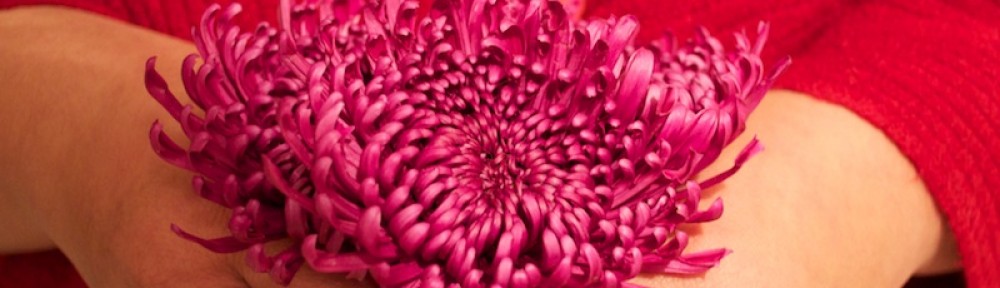
Fall in the Northwest has taught me that when the days turn gray, we just look harder for spots of bright color.

Fancy Autumn Meal for Josh: Polenta fries, Balsamic-glazed mushrooms, Garlicky Swiss chard
It’s been a while since I did a recipe post, and this one’s going to be short on pictures, unfortunately. But I posted this meal as my Facebook status update, and a few people asked for the recipes.
We had a superb time with the polenta and the mushrooms, and chard on the side. But you could mix them all together. You could add some goat cheese on top of the polenta. You could grate some Asiago or fresh Parmesan on top. You could add fresh cracked black pepper. But these 3 things together were just fine, all by themselves.

I had some versions of this meal wandering around in my head, as I was shopping at the farmers market. Mushrooms? Yes. (I’m a late convert, and I still don’t like them raw or on pizzas, but sauteed or stuffed, yes.) Chard? Always. And polenta…definitely. Since the weather had turned ventolin inhaler no prescription chilly, I’d been hungry for polenta. I made the polenta the night before, and fried the polenta the next night, Monday. It was a super-busy day, with school, C at ballet and then M with swimming right afterwards. Last Monday, because of bus schedules and swim lessons, we couldn’t pick Josh up downtown. I grabbed a few bites of the polenta and mushrooms before we headed out the door. But when he came home, he found different pieces of the meal simmering on the stove, with a lovely bouquet of smells to greet him when he walked in the door. We ate more together when I got home with the girls. That made me happy. I think we’re all going to like it here.

Part 1: Polenta Fries/Grit Cakes, adapted slightly from Matthew Amster-Burton’s Hungry Monkey
I used to be intimidated about cooking polenta, but not any more. Many recipes call for frequent stirring, stirring occasionally, and so on….for 45 minutes! But I found this recipe in Matthew Amster-Burton’s great book Hungry Monkey. If you have a kid (and even if you don’t), Matthew’s book is a fun read, but it’s also got some yummy recipes that I’ve tried and liked. I’ve been (and probably still am) a picky eater and I have liked so many recipes and ideas from this book.
The hardest part about this recipe is remembering to make the polenta and chill it overnight first before frying it the next day. Really. It’s pretty easy.
1 1/2 cup grits or polenta, preferably stone-ground (I use Bob’s Red Mill polenta)
1 1/2 cups whole milk (our family’s lactose-sensitive, so I used soy milk—see more details below)*
4 1/2 cups water*
2 teaspoons kosher salt
2 tablespoons unsalted butter, divided
*Because soy milk is thinner than whole milk, I used less water and more soy milk. I reversed the proportions of water and soy milk, so 4 1/2 cups soy milk, 1 1/2 cups water. Cooking the polenta in more milk rather than just water helps to make it, well, creamy. And more flavorful.

  1. Preheat the oven to 350 degrees F.
  2. Combine the polenta, milk, water, salt, and 1 tablespoon butter in a large saucepan. I used our cast-iron skillet, which works well, but then I have to clean it out in order to fry the polenta the next day.
  3. Place in the oven and bake 1 hour. Stir after the hour.
  4. Place the pan back in the oven and bake another 15 minutes until the polenta is thick and creamy. Add the additional 1 teaspoon butter and stir well.
  5. After the cooked polenta cools down, place it into a loaf pan (or even an 8”x8” pan) and refrigerate it overnight.
  6. When you are ready to cook the polenta fries, cut the polenta loaf into half-inch slices, or batons for fries.
  7. Using a nonstick or cast-iron skillet, fry the slices in butter (or butter plus olive oil) over medium-high heat until well-browned and crispy on both sides. You don’t need very much butter—just enough for a small coating of the bottom of the pan. Don’t touch the slices for the first 5 minutes, but each side can take up to 10 minutes to brown.

Part 2: Balsamic-glazed mushrooms
You might be tempted to add oil or butter before you do this, but don’t. Trust me. You want the mushrooms to release their liquid first and let that evaporate, then add the other flavors so that the mushrooms will absorb those instead of repelling them with water. I think I adapted this recipe from the Cha Cha Cha cookbook (Cook, Eat, Cha Cha Cha).
1 lb. mushrooms (oyster or cremini or portobello would be good), lightly rinsed and sliced about 1/3” thick
2-3 cloves fresh garlic, minced
1-2 tbsp butter
Balsamic vinegar, about 1/8 cup or a generous glug
About 1 tsp brown sugar, to taste
Fresh cracked black pepper or red pepper flakes, or both, to taste

  1. Place a cast-iron or large regular skillet over medium-high heat. Once the pan is hot enough for a few drops of water to dance across the surface, add the mushrooms.
  2. Cook the mushrooms, stirring occasionally when they start to brown. Wait for them to release their water, and cook away the water that emerges. Once the pan is mostly dry again, and the mushroom liquid has evaporated, add the butter and the minced garlic. Make sure the garlic doesn’t burn.
  3. Then, turn down the heat to medium and add the balsamic vinegar. (It will splatter if you don’t turn the heat down.) I don’t own very fancy balsamic, so I cook the vinegar, reduce it a bit and then add a touch of brown sugar.
  4. Add fresh cracked black pepper, if you want it, or some red pepper flakes.

Part 3: Garlicky Swiss chard, another recipe adapted from Matthew Amster-Burton’s Hungry Monkey
I just got used to liking spinach, fresh and in things. Started using kale in soups. I know kale’s the darling green of foodie and health folks these days. Started using chard in lasagnas, soups, other places where I used to use spinach. But chard and I are now BFFs. I buy a bunch at least once or twice a week and cook it this way. I Love Chard. Who knew? Thanks, Matthew.
1-2 bunches Swiss chard leaves (red, white, rainbow, whatever works for you) (reserve stems for another use)
1-2 tbsp olive oil
1-2 tbsp unsalted butter
Salt to taste, about 1/2 tsp to start
2 cloves garlic, minced
Pepper, if you want it
A splash of lemon juice

Heat the olive oil and butter in a skillet over medium-high heat. Add the salt and the chard leaves and stir until wilted. Add the minced garlic and stir. Cover, reduce heat to medium, and cook for about another minute. Add pepper, if you want it, and lemon juice.

Poem: A Place For What We Lose

A Place For What We Lose

1.
“I’ve forgotten the words to the national anthem,”
my father announced one Saturday morning.
Over pancakes, I sang it, and sang it for him.
I’m sure my voice cracked when the rockets, red, glared,
but I wanted to give him “our flag was still there.”

After dinner parties, he had slide shows.
I held onto numbers.
Which slides were upside down,
which ones were turned backwards?
“Sixteen! Twenty-three!”
I was my father’s child with a good memory.

I thought that I had his clear sense of direction.

2.
All kids know: counting’s different during summer.
And how summer that year blurred after he died.
My sister and I swam for June and July hours,
too far from home, in a neighbor’s green pool.

First the water was clear as love’s certainty.
Weeks later we picked out some dried olive leaves.
By summer’s end the water was murky, particulate.

By August I’d learned how to swim underwater,
to hold my breath, to lie upside buy cheap ventolin down.
I’d start facing wall, kick off hard from the wall,
then glide facing sky, watching world blur above.

3.
We find a place for what we lose,
Papa Freud told a friend who had lost his young son.
If that’s true—I’m pissed.

The place is visceral, not literal or explicable.
The place is physical, not geographic.
The place is a fucking paradox: impossible.

Or rather, to revise:
we make a place, Freud added,
shaped just like the loss.

4.
First the grief of remembering fought the relief of forgetting.
(Forgetting won, no contest. It knew how to erase. )
Then the grief at forgetting was the relief of remembering.
(Remembering crept into and nourished each space.)

5.
Did my father ask me to sing him that song?
What helped him forget? What made him remember?
I had the words. I gave them all back.

What makes me forget? What helps me remember?
I still have the words. I keep singing them back.

Seattle Star series, “The Show Must Go On”: Preparing for Drunken Telegraph

I mentioned this series last month, but I’ve compiled these posts from The Seattle Star. I’m writing a series called “The Show Must Go On” about taking my work from page to stage. It’s a series for writers who may be interested in participating in storytelling shows. It’s about writing, performing, yoga, the creative process, and—of course, the thread that connects them all—fear. The show is called Drunken Telegraph: From Pine Plank to Living Tree. Tickets are now available!

Here are the posts, along with some brief excerpts from each one. (The posts are part of the reason why I haven’t been here as often.) Thanks for reading!

Post #1, “The Show Must Go On”

“In about eight weeks, I’ll be in a storytelling show, down here in Tacoma. And having signed up for this show, I am now cursed (or blessed) with abundant irony. I am terrified that I don’t know how to tell a story.”

Post #2,”The Story We Tell Ourselves”

“I’ve signed up to do a storytelling show, though I’m not a natural storyteller. I pitched my story because being in a show sounds like fun. Because oral storytelling is a skill that I want to learn as a writer. Because I used to be a theater kid. And because as much as being in front of an audience terrifies me, I still love to perform. Then, predictably, stage fright sets in.”

Post #3,”The Structure and the Stakes”

“One piece of my self-assigned homework last week was to look at more storytelling guidelines, so I did. This set of storytelling tips on The Moth hit me hard, especially this part: the stakes of the story need to be clear to you, and to the audience. Good news, then. Just by writing last week’s post, I figured out another piece of of why this story’s been tricky. I hadn’t identified the stakes of the story yet. Bad news: I didn’t know what the stakes were yet.”

Post #4,”Off The Page”

“My plan was to write a draft of the story, and then cut and adapt the scenes. But all things work together for good, at least in this case. Before I spiral much further into angst or research or other forms of writerly avoidance and overthink-age, my producer asked if we could meet to run through the story and workshop it.”

Post #5, “Behind The Scenes (An Interview With My Co-Producers)”

“I’ve been preparing to perform in Drunken Telegraph: From Living Plank to Pine Tree, a storytelling show in Tacoma. It’s been a great adventure to think about taking my work from page to stage. For this week’s post, I’ve got an intermission post of sorts, or—to mix my theater metaphors—a behind-the-scenes interview with the show’s co-producers, Megan Sukys and Tad Monroe.”

Post #6, “The Albatross”

“After working through issues of structure, I’ve got my first headstand story pared down to several bullet events, made into bullet points, and then the takeaway, or the insight and conclusion. I’ve got my first line, and I like it: ‘Last year, I discovered how NOT to take yoga classes: like a straight-A student.”

Post #7: “A Deep and Generous Listening”

“You can take a girl out of academia, but you can’t quite take the academia out of the girl. (That’s another way, incidentally, to describe my job loss.) So, I’ve been reflecting on what I’ve learned from this storytelling show process, so far; and I know there will be more after the show itself.”

Post #8: “On With The Show”

“My voice is high and taut, thin and shaky: a tightrope of sound. I’m laughing nervously, too much for anyone’s comfort. Am I trying to make everyone laugh along with me? Does it work? I can’t tell. When will I stop laughing? Why can’t I stop laughing?”


This much of my father’s voice (The diary, part 2)

And the first questions that may be on your mind: his diary? Isn’t that private? And you’re writing it out?

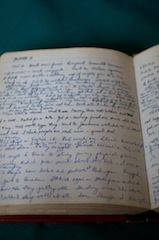
Well, yes, it is a diary. However, from what I can tell—and I’ve skimmed quite a few pages—it’s not so terribly private. There really just isn’t enough space on each page or each day for many private details, really. It is mostly a record of what happened each day. Very little space for reflection, or analysis, or introspection. So I don’t feel like I am invading his privacy, or at least in any way that he would worry about. But I do try to remember that it’s an artifact meant mostly for himself.

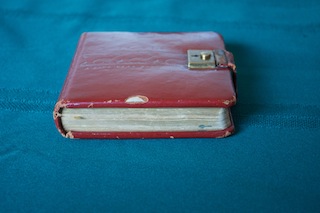
It’s a beautiful diary, though, and it’s amazing how well it’s held up over time. I give it a gentle pat each time I take it out of my computer bag.

I can’t believe how old it is. I started transcribing it almost exactly sixty years after he wrote it. There’s the thrill of the archive, the pleasure of research, that comes with transcription. It begins on his first day of boot camp. He was in the army for several years. As far as I can tell, it talks about his years in the military, including a brief stint overseas in Europe, and then about his return to the States and his first year or two of community college.

It says so much, and I have so much to say about it.

But for today I want to talk a bit about time travel. What I thought would be a linear journey through a five-year narrative has become something like an exercise in time travel, and it may be as close to tessering as I can come. My dad wrote this diary in the early 1950s, from early 1952-1956.  The funny thing is that I also know how the story ends—I know where he ends up going to school, where his career winds up, and eventually when and how he meets my mother. Part of what I’m after in writing this book, though, is the story of the middles: what happened after he left camp, before he met my mother. So I’ll be reading, transcribing, and then some reference will come along (“so and so said that July 5th would be all right”)—and I can flip to that particular day, and find out what happened. And I’m also older than he was when he was writing the diary. It’s his early twenties, for the voice in the diary. It makes me feel oddly protective of the young man that he was.

And at the same time, I am reading sooo slowly, much more slowly than I usually read. I read quickly (and then reread) often. So many of my books are books that I reread. But to read by writing each diary entry means that I am only reading as fast as I can type and then turn the pages. To read by writing makes me look, and look again. I’m not impatient with the work, somehow. I’m just luxuriating in this much time, and this much text: this much of my father’s voice.

The beauty of visible grief

Out of all the griefs there are, a child’s grief may be one of the hardest to witness.

I’m not quite sure why that is. Maybe it’s partly because children feel emotions with naked intensity. If they’re hurting, they’re hurting badly. But I also think that as a culture, we often want to protect children from death, from grief, from feeling sad. There’s some strange unwritten agreement that childhood is supposed to be sadness-free, and that it must be innocent, even though we know (or forget) that these words would not always describe our own childhoods.

Childhood is part of life, right? And all life contains some slice of sadness. Why should childhood be any different? It may even hinder a child’s emotional growth to deny them the opportunity to learn what my friend Jeanne calls the “skill” of grieving.

And still, it has been difficult to watch my oldest daughter grieve. I’ve been watching my child, and many other children, grieve for the last two weeks. It has been hard. And this has surprised me: it has been beautiful.

*****
Maybe for you too, “principal” was a word to fear when you were growing up. You only saw one if you were in trouble. Principals were Grownup and Scary, and they stayed mostly in their offices. They were somewhat like hibernating bears: you didn’t want to see them, and you didn’t want to make them angry.

But C’s principal, Bob Dahl, was a beloved leader for staff, students, parents, and community members alike. He died a couple of weeks ago. He’d been sick and out of school since last October, but I think that many of us thought that he would recover.

So many people have Mr. Dahl stories. When C went to visit school one summer with Josh, Mr. Dahl was there, unpacking boxes of textbooks for the teachers. Mr. Dahl took them around the school, looked up her teacher’s name, and showed her what her classroom would look like. He did his very best to make sure that C felt welcome and at home. This was the summer before she started kindergarten. The last time I saw her with him, she was giving him a huge hug at her first grade back-to-school welcome celebration. C trusted him very early.

I’ve heard many other stories about Mr. Dahl, and they all say essentially the same thing: he was a kind, respected, and reassuring man. All this, and we’ve only been part of this community for two years. I can only imagine what it must be like for the families who have known him as their principal for ten or fifteen years, who have watched several children grow up in Mr. Dahl’s school. I can only imagine what it must be like for the staff who worked with him for the same amount of time.

As a parent, it was comforting to see Mr. Dahl each morning and afternoon at one of the crosswalks, where he did crossing guard duty. After the first few months of school, some of the older students joined him at the crosswalk to help. At first, I thought it was just charming—a way of saying that the highest administrator of the school had something to contribute to the small everyday workings of the school.

Upon second thought, though, it was clear that crossing guard duty was one of the smartest things Mr. Dahl could do as a principal. Crossing guard duty meant that he was there at the school: he was reliable, he was visible, and he was accessible. He greeted parents and students as we came to school and as we left. Crossing guard duty was more than his office hours, because office hours require the student go to the instructor. It was his way of bringing his office down to the crosswalk.

*****
The evening after Mr. Dahl died, her teacher called us at home. (I thanked her later for the call. Imagine what it cost her to break the news to twenty-four families, while still reeling from the loss herself. She’s worked for him for fifteen years.) Though C was getting ready for bed, Josh and I decided to tell her anyway, instead of waiting for the rush of morning activities. We sat her on the couch between us, and explained that Mr. Dahl had died. We had explained death to her when she was a toddler, in the simplest possible terms—that someone’s body stops working. (A flexible thinker even then, she thought that death meant that they needed to get new batteries.) A distant family member died a couple of years ago. A family pet had died a year before that. We’ve talked about my dad, and she’s now old enough to be a little sad about the grandfather she never got to meet. But Mr. Dahl was the first person that C knew who died. This is really the first death that she’s old enough to understand. When we told her she buried her face on her dad’s shoulder, and she cried a bit. “Why?” was her first question. We talked about it some more. And then we read her some extra stories, and tucked her into bed.

What I really want to tell you about, though, is how amazing it has been to watch this elementary school, this larger community, teach my child how to grieve.

*****
When I dropped C off at school that Monday morning, parents and staff were already weeping and hugging at the playground. But thanks to the school district, grief counselors were available the next day for the entire school, including parents, staff, and caregivers. The counselors had been pulled from other elementary schools that day. If kids became too sad to function in class, ventolin inhaler generic they went to the library, where they could talk to counselors, and do simple activities like coloring or doing math problems. Many classes did some form of activity to honor him, even the kindergarten classes. C’s class, which usually talks about kind words and deeds in a “kindness circle,” formed a circle to talk about Mr. Dahl and his kindnesses. They made a book of drawings and notes to give to his family.

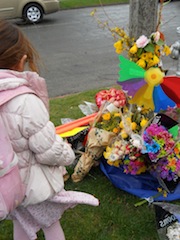
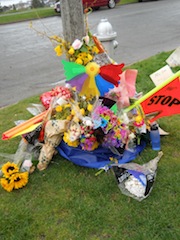
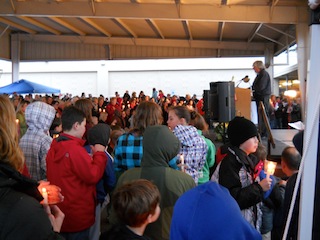
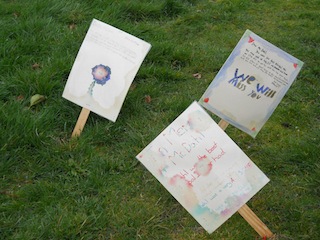
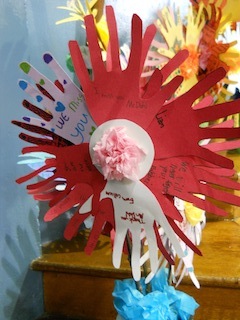
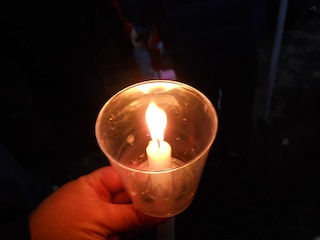
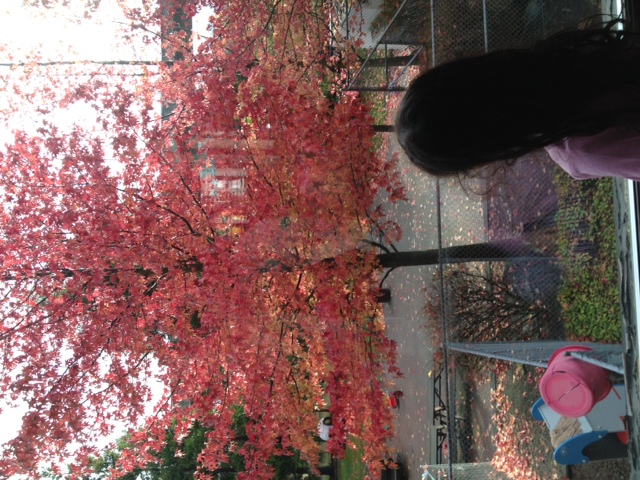
And then there came the visible symbols of public grief, which have been equally heartbreaking and heartwarming. Two classes, whose rooms face the street, painted murals on their windows: “We love you Mr. Dahl.” Flower arrangements arrived from neighboring schools, and were placed on a table near the main school office, with a guest book to sign. That very afternoon, the school marquee changed to mark his passing. This week, students and parents have written on colored plastic memory flags, and tied them to the chain link fence surrounding the school playground. (You can see some of them in the first photo, above.) Many students wrote messages and traced their handprints onto colored construction paper, and someone made these into flowers to decorate the stage in the school cafeteria. The hallways are filled with the children’s letters and drawings for their principal. At the candlelight vigil that the school held this week, the school chorus sang a song that two students had written for him.

And for two weeks now, there has been a steadily growing pile of bouquets, handwritten letters, illustrated signs, and balloons at the northwest corner of the school. Members of the school community have laid these at the crosswalk where Mr. Dahl used to stand every day.

*****

At our house we’ve talked about Mr. Dahl off and on, whenever C wants to raise the subject. Though it makes C sad to talk about him, I think it is also comforting to her that she can talk about him. Yesterday she brought home two things: a wallet-sized picture of him, and a blue plastic bracelet that says, simply, “[Our school] loves Mr. Dahl.” After the memorial flowers have wilted, and the signs have come down from the hallways, the children will still have this bracelet that they can wear as a symbol of collective mourning.

Not so long ago, in Victorian England, mourners wore special clothes which were black, and (after a time) half-mourning clothes which were lilac or gray. Having to wear these clothes might feel somewhat restrictive now, I know. But I’ve been wishing for those outward symbols of mourning. If you’ve been reading here, you know already that I’m writing a book about my father, and his early death when I was ten, and that this book is partly my way of grieving. It’s taken me far too long—well over two decades—to learn how to grieve my father.

I wasn’t sure how I’d be able to help my daughter grieve, or if I could stand to watch her grieve. I think that if I hadn’t been writing the book, I would have wanted to detach from far too much these past few weeks. I would have avoided talking about it, asked her not to talk about it. And I probably would have avoided the school as much as I could. I would have stayed away from anything like a memorial service or candlelight vigil.  I think I would have sprinted towards full emotional retreat. Emotional detachment’s been my coping mechanism for far too long.

Now I wish that I’d had something like C’s blue bracelet to tell the world that I was in mourning when my father died. Sometimes I felt as though I was in a completely different planet than almost everyone else, and I couldn’t remember how normal life felt. Maybe because I was a child, I felt strangely important. I knew that this massive catastrophe had happened and I was one of the few people who knew about it. I wish I’d had a bracelet or a sign, even a sandwich board I could wear, that said, “My father’s just died.”

And yet I don’t know how many people would have talked to me if I had worn such a sign. Why is there such a silence around grief?

I’m thinking of so many people I know who have lost someone vitally important to them. I’m thinking of family members and friends who have lost loved ones to aging, miscarriages, illness, suicide, accidents, abandonments. Some of these deaths have happened under brutal and inexplicable circumstances. There are so many of us, walking around with so much loss, and we don’t really know each other. I bet we could have a sandwich board party, those of us in the Grief Club. I bet the membership would be larger than any of us would expect. But we don’t speak enough about our losses to each other. Shouldn’t we be able to offer more than “I’m sorry”’s to each other?

*****

These last two weeks have been hard. And they’ve been beautiful. My daughter’s elementary school community has taught her how to grieve. The teaching’s happened not through direct instructions or textbooks, but a tapestry of collective actions. And I’m so grateful that it’s happened in terms that she can understand:

It’s okay to be sad. It’s okay to cry. Crying might even make you feel better.
It’s kind to comfort other people who are also sad.

We are never alone in our grief, though it often feels that way.

Beauty is not only possible but crucial at these times. It unfurls when we need it most.

And finally, one of the best things to do with grief is to bring it into the light.

I take it back

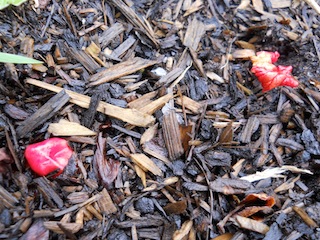
The skies were cool and gray, and they’d been that way for weeks. At first these looked like red beads, or berries that had fallen from a nearby bush.  So when I walked towards the back of our yard, taking out the garbage, two red dots in the garden bed caught my eye. On my way back inside, I thought I’d check to make sure that the berries were still there.
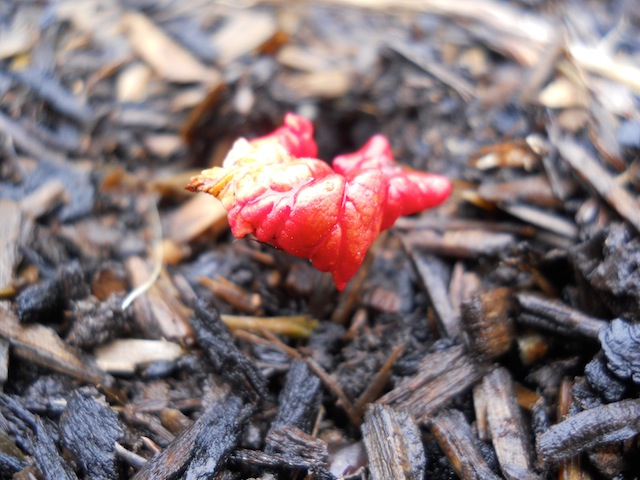
They weren’t. They were tiny heads of rhubarb, getting ready to come back from the winter.

 *****

It’s funny, the hobbies I’ve picked up since I moved to the Northwest from California. Cookbook collecting. Jam-making. And, funniest to me, gardening. I’m terrible at houseplants, so cross your fingers for the two plants I’m managing to keep alive. (Jade and Ruffles, I hope your days are not numbered.)

And gardening’s something that I never understood. It sounded mind-numbingly boring, something I’d ranked up there with home decoration as Grownup Old People hobbies. For a very long time, I remember snorting and tossing away the gardening and home decor sections of the Sunday newspaper—who does these things? (People who have gardens and homes to decorate, I now understand. Along the same lines, I never understood the appeal of a yard with a lawn until I had one. It’s like a park….behind your house!)

When I moved to the Northwest, I thought it was quaint that the number one hobby here is gardening. It really does make us sound like a region of nice senior citizens, puttering around with our pruning shears and shaking our passive-aggressive fists at, I don’t know, the non-recyclers. Gardening! I take it back now, I really do.

Not a yard with ornamental bushes, though we do have some of those. I mean, a garden, with raised beds for food. Except for those dates in high school, food gardening is some of the most fun I’ve ever had outside. I’m not a hiker, I’m not a kayaker, I’m not a skiier….all those Northwest pastimes that I’m supposed to enjoy. But I do love having a garden.

Since we started our garden, we’ve had some amazing years and some not-so-great years. We’re nowhere near Barbara Kingsolver’s family in Animal Vegetable Miracle, able to raise and put up food for an entire year. We’ll be regular farmers market customers for a very long time. But we’ve had tomatoes, lettuce, zucchini, Rainier cherries, and blackberries, all from our own garden: from our own backyard. Summers have been quietly delicious.

(First, cookbook collecting, then jam-making, and now food gardening. Upon reflection, the senior citizen part of the gardening stereotype may not be too far off. I’ve turned into my grandmother, who loved all of these things.)

 *****

Last year wasn’t a great garden year. We had high hopes, since the Rainier cherry tree had snowballs of blooms that nearly covered the branches. The blooms weren’t pollinated enough, though. (We’re trying Mason bees this year, which are supposed to pollinate more than honey bees and aren’t as prone to stinging humans.) We planted some basil, lettuce, zucchini, tomatoes, and these performed modestly well. And for the coming year, we planted rhubarb and strawberries. With both of these crops, it’s recommended that you don’t harvest anything the first year (even down to pinching off the blooms of the strawberry plants), leaving the plants to conserve energy towards the next year’s harvest.

I bought a rhubarb crown, planted it, watered it but-not-too-much, and hoped. It obligingly grew several large leaves and stalks. And then at the end of summer it died, shriveling into a brown fist. Our next-door neighbors have an incredible set of rhubarb plants, and those didn’t seem to have died altogether. So I thought that was it. I’d let my rhubarb die.

 *****

And then: those drops of red in the garden that day. The rhubarb was coming back.

Northwest sap that I now am, I nearly cried. I had to look so closely at the plants, to make sure they were not berries dropped in the garden bed. These pictures are about as close as I could get to the crowns, and even then, they look bigger because I stuck my camera so freaking close to them. Those wood chips in the pictures? They’re probably no longer than a knuckle on your finger. I’m surprised they didn’t put up celebrity hands in self-defense—no papparazzi, please.

The color was just what I needed to see on such a gray day, after months and months of gray days. Our color palette here is mostly greens and grays and blues, and while I’m grateful for the greens, I also miss other colors during the winter. By the time spring comes back, glorious blossoming spring, I’m ready for the color.

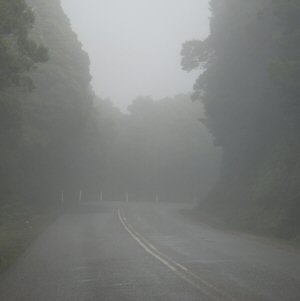
Color may be one reason why we love to garden in the Northwest. But this year, gardening’s also about renewal, about second chances, about plain brown patience and rich green reward. I needed to see that, especially on a day like that day, after a winter like this winter has been. I’m still working through the occasional grieving, still driving through the uncertainty fog, and I still don’t know what will happen next.

The garden reminded me how to look, and what to see. “The rhubarb’s back! The rhubarb’s back!” I told C, and we ran to the backyard so she could see it, too.

Girl’s Day (Hina Matsuri)

It’s been one of those weeks when I’ve been writing bits and pieces, but not a nice satisfying chunk of writing. That’s okay–at least, I am trying to remind myself that this is okay.  All of it is part of the process. But it’s hard to trust the process on some days. Yesterday I took Anne Lamott’s “one-inch picture frames” approach and just tried to write as many small moments as I could. I’m not sure that these will make it into the book, but it’s clear so far that I needed to write them down, if only to download them from my brain.
I promised you some small breaks from the writing process here. So I wanted to tell you about the Girl’s Day celebration we had this year.

About Girl’s Day
Girl’s Day is a Japanese (and Japanese American) holiday, originally intended for little girls and their families and celebrated every year on March 3rd. We have a book about Girl’s Day and Boy’s Day, with photos and traditions, mostly intended for kids in Hawai’i. When C read about Girl’s Day and asked if we could celebrate it too, I couldn’t say no. I want her and her sister to know about Japanese culture, to know that this is part of who they are.

Girl’s Day (Hina Matsuri) is the Festival (matsuri) of Dolls (hina). Most traditionally, the family has a set of  hina that they take out every year for a few weeks before March 3rd. The hina are usually dressed in the court robes of the Heian era. Some sets are as small as just the emperor and empress on a stand, while one famous set in Japan has over a thousand dolls.

I never celebrated Girl’s Day when I was growing up, but this fact also means that I got to play with the day and the traditions as I went along. There are lots of traditions about Girl’s Day, and while I love some aspects of these traditions, I also like adapting tradition in order to keep the day meaningful and fun.  Hiragana Mama‘s collection of links about the day was especially helpful.


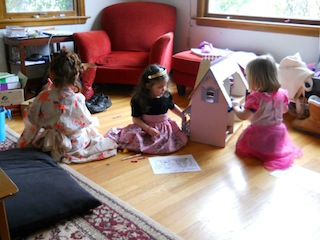
We made the day about dressing up fancy, eating special food, and playing with dolls. Josh finally finished making the dollhouse from a kit that we bought for Christmas, so the girls got to play with the dollhouse, too.
Ultimately, I wanted to keep the intention of Girl’s Day, which is about connecting girls to their families,  letting the girls know that they are loved and cherished.

The food
All of the food served on Girl’s Day symbolizes something, including hopes for the girls’ longevity, strength, and purity. A clear soup with clams is sometimes served, but I didn’t think any of our girls would like it this year. (Some of the food is offered to the dolls themselves, but I forgot this part. I’ll buy a small bowl to place by the stand (hina dan) next year. A sake cup might also work, since it’s the right size.)


Other foods that we served:

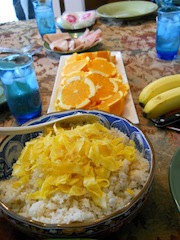
  • Thin egg crepes over rice from this recipe
  • Orange slices cut into flower shapes. We used to cut these up for dinner parties when I was little, and my family still likes to serve these on New Year’s Day.
  • Pink and green mochi. The mochi are supposed to be diamond-shaped, and they’re supposed to be pink, green, and white. I almost made the mochi, but decided it might be too much work (with everything else). Josh brought some guava and kiwi mochi from Uwajimaya, which was just fine.
  • Crepes. Yes, I know these are French, but here’s my reasoning: Japanese people are really good at making crepes. And some of the best crepes I’ve had are from places in Japantowns. I sweetened some cream cheese with powdered sugar, and made some strawberry sauce. I also had some ham, turkey and cheese. We presented them as fancy pancakes, and the girls loved them.

Clothes
Girls usually dress up in kimonos and have their pictures taken next to (or in front of) the hina dolls. I actually have two things which were appropriate here: the yukata that my relatives had made for me when we visited Japan, so long ago, and an orange Korean robe which my sister sent to C. M didn’t want to wear her robe, which was fine. I just let her (and her cousin) ventolin tablets 4mg dress up in fancy dresses. C looked adorable in the yukata, though. Both girls wore hair accessories that my auntie had bought in Okinawa.  I wanted them to feel comfortable, but fancy, and special.

The hina (dolls) and their hina dan (doll stand)
This project took a while, but I’m a crafty sort of girl. I love taking materials that are available and then transforming them into something else. There are a whole bunch of wonderful cutouts online that you can download and print off. But these didn’t feel right to me. (I did print off a coloring page for each of the three girls, as a sort of party favor for the day.)

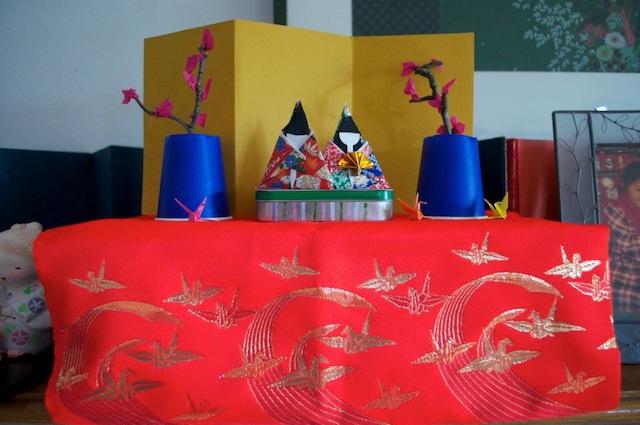
  • The dolls: I made the emperor and empress dolls, adapting this set of origami guidelines along with a washi ningyo kit that came with black crepe paper for hair and cutout white circles for faces. I made a small gold sensu for the empress, who often appears with an open fan. The emperor’s hair is shorter and more like a topknot. And then I made very simple stands (shaped like Vs, attached to the back of the dolls) which help the two dolls to sit up.
  • The doll stand: The emperor and empress appear on a stand, which is usually striped. I took an Altoid tin and drew stripes on the front. I also used a folded sheet of gold cardstock as a makeshift screen behind the dolls. Next year I’d like to make the screen fancier, maybe with a cutout decoupage from origami paper.
  • Cherry blossoms: And I knew that I wanted to make cherry blossoms. I’d been looking at this project for a while. So I picked two twigs from our backyard that looked small and interesting enough. I twisted small triangles of pink tissue paper and glued these onto the branches. I took paper cups, deconstructed one to make a template, and then covered the paper cups with blue origami paper. I turned the cups upside down and stuck the branches into the bottom.
  • The hina dan (doll stand): The actual stand is a black box that contained some beautiful Japanese bowls. Over the front, I draped a swath of obi fabric that my friend Marcy had sent me from Japan. It has gold origami cranes embroidered all over it. And, just for good measure, I folded three tiny cranes and put them in front of the dolls. Here’s how it turned out:


Family
I wanted this day to be a day of celebrating little girls and family. So we invited my niece, as well as her parents, though they’re not Japanese. And we invited one of my best friends, B, and her boyfriend. Though B grew up in Kansas, she had read about Girl’s Day when she was a little girl. My girls have adopted her as an aunt. She brought a copy of an old children’s book, The Japanese Twins, which is about a little boy and girl growing up in pre-World War II Japan.

And I wanted to connect the day to my family, too. I mentioned that I didn’t celebrate the day while I was growing up. However, I have a picture that my sister framed and gave me. It’s a picture of the two of us in front of my grandmother’s set of hina. I put that picture next to my hina dan, and then put a picture of my daughters and my niece next to that. I wanted to connect those little girls with the little girls that my sister and I once were.

Traditionally, a big focus of Girl’s Day is marriage. As I understand it, this is why the hina are supposed to be from a Heian wedding. The day is supposed to represent your hopes for the girls’ future. But I didn’t really want marriage to be the focus here. If they want to be married eventually (far, far, far in the future), that’s great; if not, that’s great, too. Instead, my sister-in-law and I wrote short notes to the girls, describing our hopes for them. I’ll keep these notes and I hope that we’ll add to this jar of notes every year.

What special holiday traditions do you celebrate in your family? How have you adapted these traditions (or not), and why?

Two steps forward, one step back


“Writing is like driving at night in the fog. You can only see as far as your headlights, but you can make the whole trip that way.” ? E.L. Doctorow

In the two steps forward news, I’ve written a little over two thousand words of the Introduction to the book this week.  I’m already feeling out ways that I need to develop myself as a “character” in the book. I’m feeling how I need to adjust my pacing for this longer work, something like a marathon might feel. Blog posts and other things that I’ve written this year are very short, and the high point of the action occurs pretty early.

I can feel how my prose and descriptions are stretching themselves out. In these posts, the descriptions can afford to be lush occasionally, but this quality might feel overwritten or overblown (or overwhelming) in a longer work.

I can feel how I don’t want to give too much away in the Introduction, but I want people to come into the room and stay awhile. I’m not sure buy albuterol online exactly where I’m headed next, but it feels like E.L. Doctorow’s headlights on a nighttime car trip–I don’t have to see the entire way, just as far as the headlights will let me.

And I’m trying to write at least a thousand words a day.

Last week, Anne Lamott told us to “write what you love to come upon,” or write about what you would love to read. So far, then, my invitation to the reader is about reading–which is no surprise for anyone who knows me.

****

In one step back news, this weekend marks the one-year anniversary of the tsunami and nuclear disaster in Japan. I’m humbled by the resilience of the Japanese, as I knew I would be. Look at these “before and after” pictures.

But I’m also aware that physical rebuilding and psychological renewal may not be the same thing. I’m posting a link here to my post from last year. The story of a tsunami doesn’t end when the wave breaks; in fact, for humans, that’s when the story begins.